
Your Bag is Empty
Most people who walk into my showroom have already done their homework. They know about the 4Cs. They have opinions on oval versus round. They have read about lab grown versus natural. Some of them know more about diamond specifications than they will ever need to.
But in twenty-five years, I can count on one hand the number of clients who have asked me about fluorescence before I brought it up myself.
It is one of the most misunderstood characteristics in the diamond world — and one of the most overlooked. Some jewellers see it as a benefit. Others avoid it entirely. Most never mention it at all, and their customers have no idea it exists until they notice a line on a grading report they were not expecting.
A recent experience with a couple in my showroom is actually what prompted me to write this. More on that shortly.
So let me explain what fluorescence actually is, why it matters less than most people fear, and why it occasionally matters more than most jewellers admit.
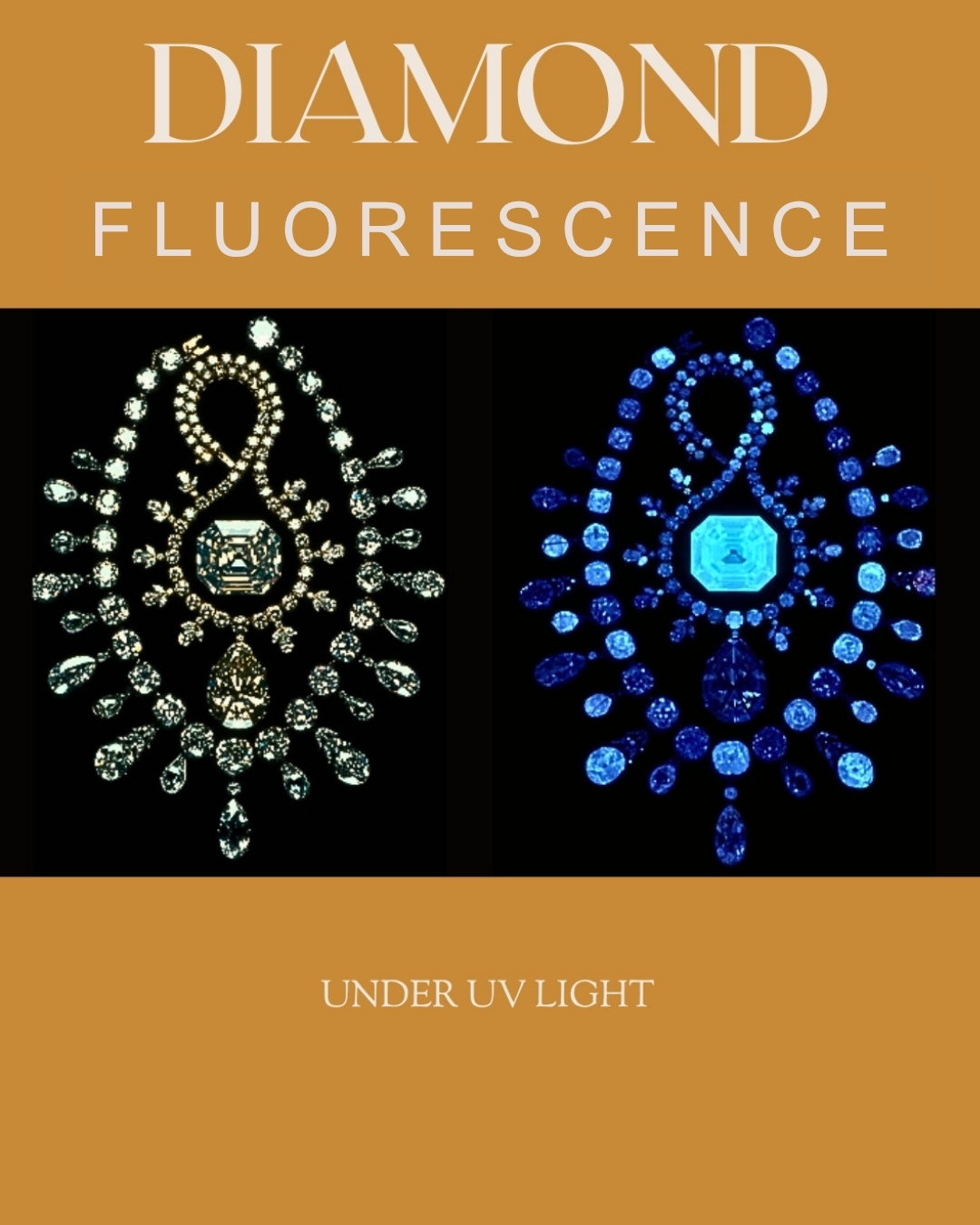
Fluorescence is a natural reaction that occurs in some diamonds when they are exposed to ultraviolet light. In most cases, the diamond emits a soft blue glow — though occasionally yellow, green, or white — when placed under a UV source.
It is graded on a simple scale: None, Faint, Medium, Strong, and Very Strong.
Here is the part that surprises most people: fluorescence is not rare. Roughly a third of all diamonds submitted to the GIA show some degree of fluorescence. If you have looked at five or six diamonds during your search, the chances are that at least one or two of them were fluorescent. You almost certainly did not notice.
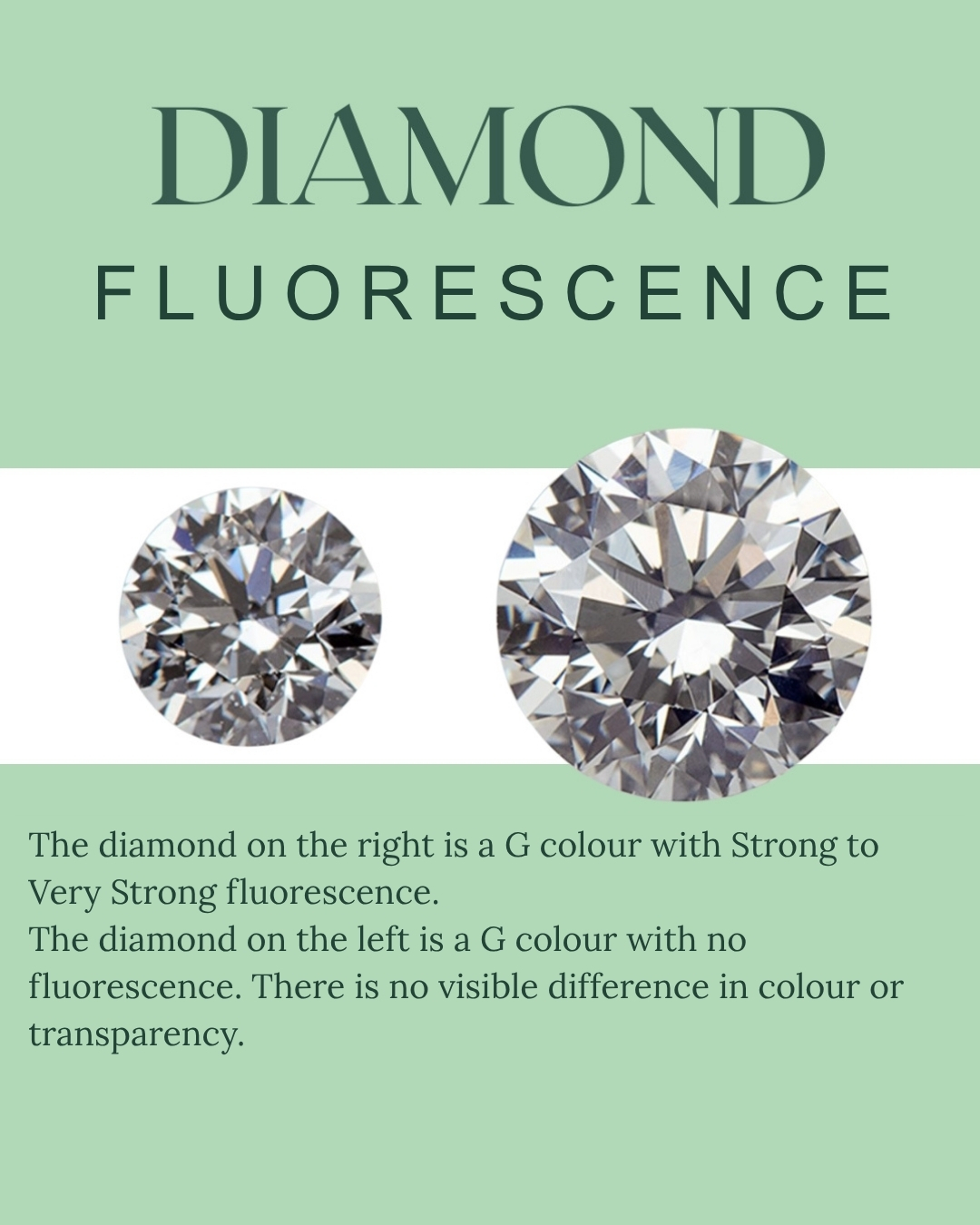
In everyday lighting conditions — indoors, outdoors, in a restaurant, on your hand — faint to medium fluorescence is virtually invisible. You would need a UV lamp to see it.
In my experience, there are two reasons fluorescence gets left out of the conversation.
The first is practical. Most buyers are already overwhelmed. They are trying to understand cut, colour, clarity, and carat weight. Adding another variable feels like too much. Most salespeople — and I include some jewellers in this — take the path of least resistance and simply do not raise it.
The second reason is more interesting. Fluorescence does not fit neatly into a good-or-bad category, and people find that uncomfortable. We like certainty when we are spending thousands of euro. We want someone to say "this is better than that." Fluorescence does not work that way, and so it tends to get quietly ignored.
That is a shame, because understanding fluorescence can actually save you money.
Here is where it gets genuinely interesting.
In the United States, many jewellers have historically viewed medium blue fluorescence quite favourably — particularly in diamonds with higher colour grades, D through G. The reasoning is straightforward: a subtle blue fluorescence can sometimes counteract faint yellow tones, making the diamond appear slightly whiter to the naked eye. Some American dealers actively seek out fluorescent stones for this reason.
And yet the broader diamond market discounts them.
A diamond with strong blue fluorescence in the D to F colour range can trade at ten to fifteen percent below an identical non-fluorescent stone. Medium fluorescence might cost five to ten percent less. The discount narrows as you move down the colour scale, and for lower colour grades — I, J, K and below — medium blue fluorescence can actually be seen as an advantage because of that whitening effect.
This creates something I find fascinating: a diamond that looks equally beautiful to the eye, sometimes even slightly better, but costs meaningfully less because of a market perception rather than a visible flaw.
For buyers who are willing to judge a diamond by how it actually looks rather than by what a specification sheet says, fluorescence can quietly be one of the smartest ways to get more for your money.
Recently, a couple came to me looking for a 3.5 carat round brilliant — a significant purchase by any measure. They had done their research and they knew about fluorescence, but like most people, they had come away with the impression that it was something to avoid.
I walked them through exactly what I have just explained to you. We looked at two comparable stones side by side. The fluorescent diamond was lively, bright, and performed beautifully under every lighting condition I tested it in. The fluorescence had no visible impact on the stone whatsoever.
They chose it — and saved eight thousand euro.
That is not a compromise. That is what happens when you understand what fluorescence actually means rather than what the internet tells you it means.
I am not going to pretend fluorescence is always irrelevant.
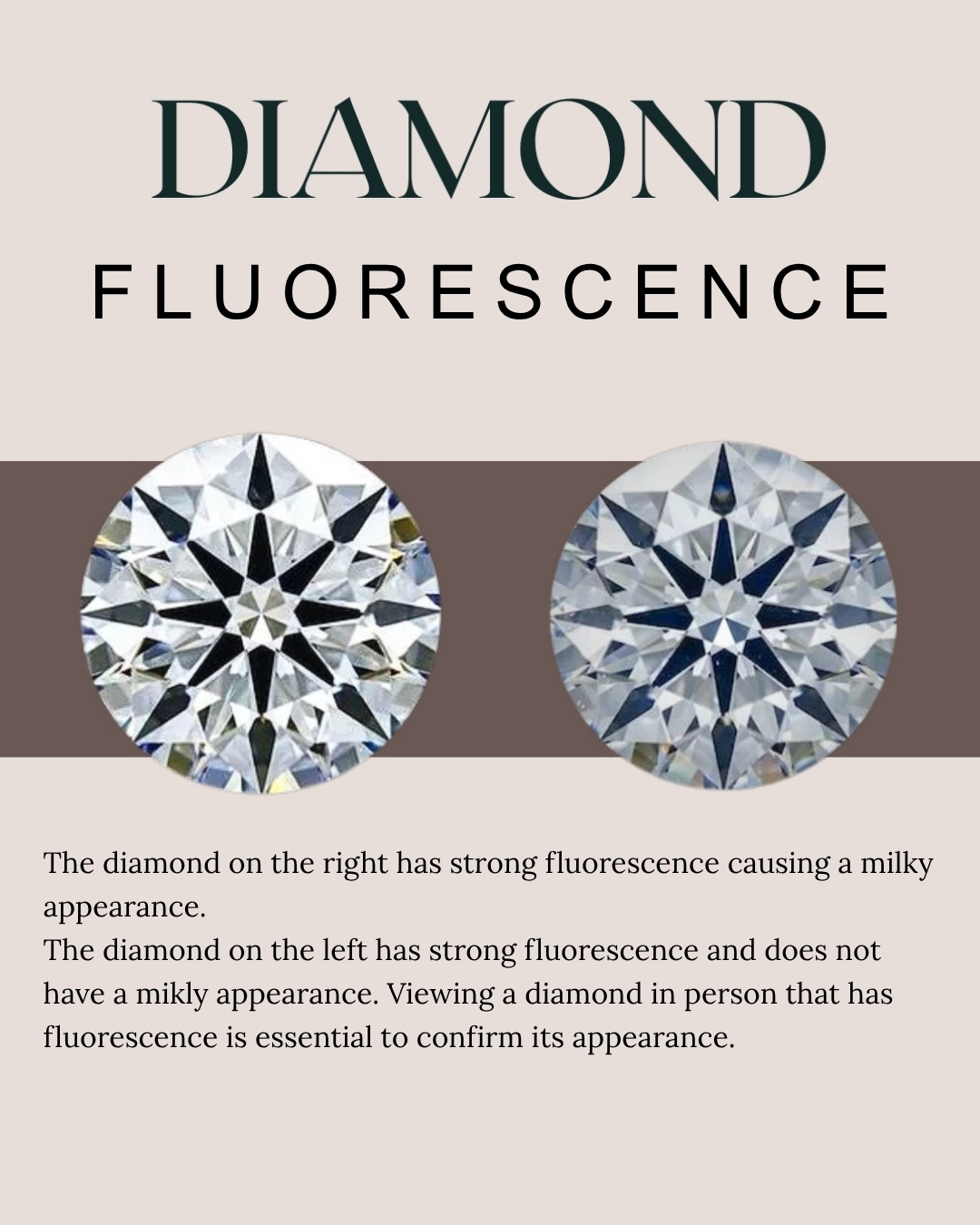
In a small percentage of cases — and I want to stress it is a small percentage — very strong fluorescence can cause a diamond to appear slightly hazy or milky. Instead of the crisp, lively sparkle you expect, the stone looks a little dull, as though you are viewing it through a thin layer of fog.
This is not common. Most diamonds with strong fluorescence look perfectly fine. But it happens enough that I check every stone individually rather than making blanket statements. A grading report can tell you that fluorescence exists. It cannot tell you whether it has affected the diamond's appearance. That is something you either need to see for yourself or trust your jeweller to assess honestly.
When I source diamonds, I look at the stone first and the report second. If a fluorescent diamond is lively, bright, and performs well in different lighting conditions, the fluorescence is irrelevant. If it looks hazy, it goes back regardless of what the rest of the certificate says.
Yes, they can.
Both natural and lab grown diamonds may display fluorescence under ultraviolet light. However, the behaviour is not always identical.
HPHTlab grown diamonds — those created using high pressure, high temperature — sometimes display phosphorescence, which means they continue to glow briefly after the UV source is removed. It is harmless and temporary, but it is one of the ways a gemologist can identify the origin of a stone.
CVD diamonds — created through chemical vapour deposition — may show different fluorescence patterns again, sometimes orange or red under certain testing conditions, though this is rarely visible in normal wear.
For most buyers, the key takeaway is simple: fluorescence is not exclusive to natural diamonds, and its presence in a lab grown stone does not indicate a quality issue.
If someone asks me about fluorescence, I tell them exactly what I have just told you.
It is worth understanding. It is not worth fearing.
If you are looking at two diamonds and one has medium blue fluorescence and the other has none, and the fluorescent stone looks just as beautiful but costs eight percent less — that is not a compromise. That is a smarter purchase.
But I would never tell someone to seek out fluorescence for the sake of it, or to ignore it completely. Like most things in diamond selection, context matters. The individual stone matters. And seeing it in person matters far more than reading about it online.
A certificate will tell you that fluorescence is present. It will not tell you whether the diamond is beautiful. That is still a conversation best had in person, with the stone in front of you, under real light, on a real hand.
If you want to understand how fluorescence affects the diamonds you are considering, come in. I will show you the difference — and more often than not, the difference is far smaller than the internet would have you believe.
Eric McGuire is the founder of McGuire Diamonds in Gorey, Co. Wexford. He has been designing and handcrafting engagement rings since 2000.