
Your Bag is Empty
Book an Appointment
"Eric, these two diamonds have exactly the same grades. Why is this one more expensive?"
It is a fair question.
If two natural diamonds are both 1ct, F colour, SI1 clarity, Excellent cut and have GIA grading reports, you could reasonably assume they are essentially the same thing.
One might be €3,900 and another €4,350.
So why would you pay more?
The obvious conclusion is that one jeweller is simply more expensive than the other.
Sometimes that may be the case.
But very often, you are not actually comparing the same thing.
This is one of the most misunderstood parts of buying a natural diamond. The 4Cs are extremely useful. A recognised independent grading report is extremely important. They allow us to describe, filter and compare diamonds in a way that would otherwise be almost impossible.
But they do not make two diamonds identical.
I have been buying and selling diamonds for over 26 years and, when I am selecting a natural diamond for a client, the 4Cs are normally where I begin.
They are not where I finish.
Usually a client gives me some idea of what they are looking for. Perhaps they want a 1ct round natural diamond, F colour, SI1 clarity and Excellent cut.
I can put those requirements into our diamond inventory and immediately narrow a huge international market down to a much smaller selection.
At first glance, the results can look very similar. Same carat. Same colour. Same clarity. Same cut grade. Same grading laboratory.
And sometimes very different prices.
This is where you have to start looking beyond the headline grades.
Because an SI1 is not simply an SI1. An Excellent cut is not one exact set of measurements. And a 1ct diamond does not necessarily look exactly the same size as another 1ct diamond.
Clarity is probably the easiest way to demonstrate the problem.
Take two GIA-graded SI1 diamonds. It is tempting to think that because both received SI1, they contain roughly the same amount of inclusions. That is not how clarity grading works.
The type, size, number, position and visibility of those inclusions all matter. For me, the position is particularly important.
If I have a choice between an SI1 with several very small, dispersed inclusions that are difficult to see with the naked eye and another SI1 with a more obvious inclusion sitting under the table, I know which one I am going to look at first.
I am trying to find the cleanest-looking SI1 I can for the client's money.
Both diamonds may quite correctly have SI1 written on their grading reports. That does not mean I consider them equally desirable.
This is also why I do not automatically tell clients that they need to buy VS, VVS or Flawless. If I can find an eye-clean SI1 where the inclusions are small, well positioned and do not detract from the appearance of the diamond, that can represent excellent value. Why spend money on a clarity difference you may never be able to see?
But equally, I would not recommend a poor SI1 simply because it allows me to advertise the cheapest 1ct F SI1.
Those are two completely different approaches to value.
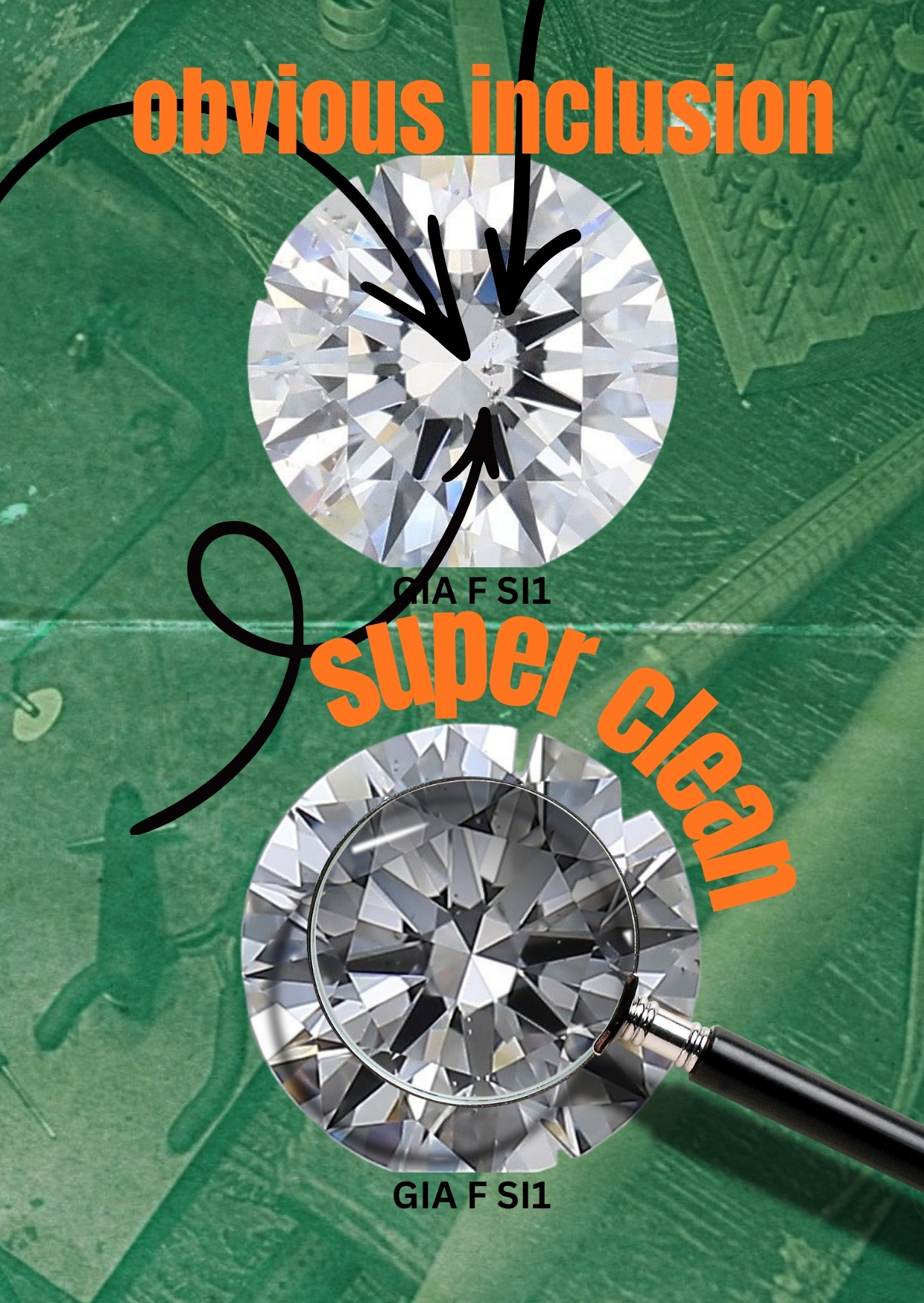
A client came to see me recently looking for a 1ct F colour, SI1 natural diamond.
She had already been given a quotation by another jeweller, although I did not know that when we started talking.
She sat in front of me and gave me the usual criteria: size, colour and clarity. We had not discussed the other quotation or even got properly into price at that stage.
Naturally, she wanted the best stone I could find within the criteria she had given me.
So I searched our inventory and offered her the stone I thought was the best choice.
The price was €4,350.
I could tell she was a little disappointed. After dealing with people for 26 years, you get reasonably good at knowing when something is not quite right.
So I asked her directly.
"Have you been given a better price?"
She said she had. The other quotation was €3,900.
Now I was interested, because I believe we offer extremely good value and I wanted to understand the difference.
Luckily, she had the quotation in an email and it contained enough information for me to identify the diamond.
I searched the stone on our live inventory while she was sitting in front of me.
There it was.
We could supply the exact same diamond.
Our price was €3,170.
In other words, I could have supplied the diamond she had been quoted elsewhere for €730 less.
But I still would not have recommended it.
Why?
Because although it met the requested headline criteria, I did not think it was a good stone. It had a large, noticeable inclusion around the table area and was not an SI1 I was happy to recommend.
The diamond I had selected at €4,350 was not more expensive because we were necessarily more expensive. It was a different diamond. And, in my opinion, it was a much better choice.
That story sums up a large part of what people need to understand when comparing natural diamond prices. Initially, the client thought she was comparing like for like. She was not. She was comparing two different diamonds that happened to share the same headline grades.
Once we identified the exact diamond she had been offered elsewhere, we finally had a true like-for-like comparison.
And at that point, comparing price made perfect sense.
This is particularly important with round brilliant diamonds.
Two diamonds can both carry an Excellent cut grade without having identical proportions. Table percentage, depth percentage, crown angle, pavilion angle, girdle thickness — all of these can vary within the Excellent range.
I am not suggesting clients need to learn these measurements. That is our job.
But the point matters: two diamonds with the same cut grade on the report can look and perform quite differently when you examine them properly. One may face up slightly larger. One may handle light better. One may simply look more alive.
The cut grade tells you that a diamond has been cut within a certain range. It does not tell you that it has been cut identically to every other diamond in that range.
This is an important distinction that catches a lot of people out.
Two round diamonds weighing exactly 1.00ct do not necessarily have exactly the same face-up diameter.
A stone that is cut too deeply can carry weight where you do not really benefit from seeing it. You are paying for 1ct, but some of that weight is effectively hidden in the depth of the stone. The result can be a diamond that faces up smaller than you would expect for its carat weight.
At the other extreme, a stone that is too shallow may have an unusually large diameter but compromise light performance. Bigger spread is not always better.
The objective is to find a stone where size, proportions and light performance work together. Not simply the widest diamond or the heaviest.
I have no problem whatsoever with clients comparing prices. They should. Natural diamonds can cost a lot of money. It is perfectly reasonable to find out whether you are getting good value.
But make sure you understand what you are comparing.
If two jewellers are offering the exact same diamond — same stone, same grading report number — then you have something meaningful to compare. Compare the price. Ask what is included. Consider the ring, the setting quality, the service and aftercare.
If they are two different diamonds with the same 4Cs, you have not established like for like yet. Look further.
When I was beginning in the diamond business, I was friendly with a highly regarded diamond wholesaler. I was still learning and would ask questions when something did not make sense to me.
On one occasion I found two natural diamonds on the market. From memory they were approximately 2ct, GIA graded and Flawless, and as far as I could establish they were equal in every meaningful specification.
There were only two available that matched what I was looking for.
One was approximately €40,000. The other was approximately €48,000.
That is a big difference.
I went through the information trying to work out what I was missing. Eventually I asked my colleague.
Why is one €40,000 and the other €48,000 if they are essentially equal?
His answer has stayed with me ever since.
"When the €40,000 stone is sold, there will only be one left on the market."
That was it.
There was not necessarily another percentage I had missed. There was not necessarily something wrong with the cheaper stone. There was not necessarily something wonderful hidden inside the dearer one.
There were two. Then there would be one.
Supply, demand and availability matter. Natural diamond pricing is not always as neat as people would like it to be.
Everything I have written above could accidentally leave the impression that when two diamonds have the same grades, the more expensive one must secretly be better.
Absolutely not.
Sometimes the cheaper diamond is the one I would recommend. Sometimes two diamonds are so close that I cannot justify paying the extra money for one of them. If I can save a client €500 without giving up anything I consider meaningful, why would I not?
The objective is not to find the most expensive diamond the client can afford. It is to find the best diamond I can within the budget they want to spend.
Sometimes that means spending a little more. Sometimes it means spending less. Sometimes it means accepting a sensible compromise in one area to get a better overall stone. And sometimes the cheaper stone is simply the better buy.
That is what value means to me.
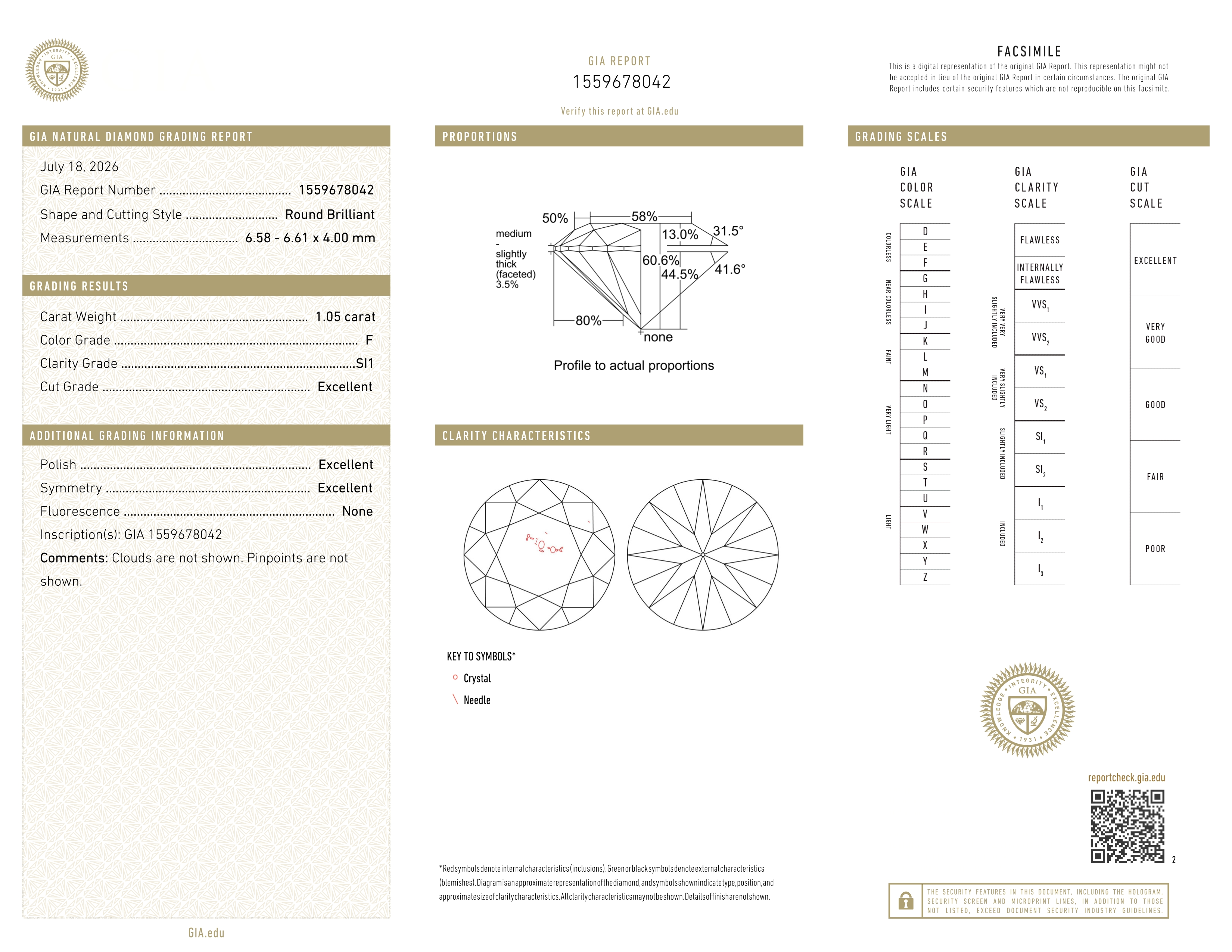
A grading report is one of the most important tools we have when buying a natural diamond.
Use it. Read it. Compare it. Make sure you understand what you are buying.
But do not assume that matching certificates create matching diamonds. They do not.
The 4Cs allow us to put diamonds into categories. Within those categories there can still be substantial differences.
Two SI1s can have very different inclusions. Two Excellent round brilliants can have different proportions. Two 1ct diamonds can face up differently.
A grading report describes and identifies a diamond. It is not the diamond itself. We are trying to buy the best diamond for the money. Not the best piece of paper.
So if you are comparing natural diamond prices, please do. I have no issue with that.
Just make sure first that you are comparing like for like.
Because sometimes like for like exists.
And sometimes it does not.
Eric McGuire is the founder of McGuire Diamonds in Gorey, Co. Wexford. He has been designing and handcrafting engagement rings since 2000.